Financial Reporting has become one of the fastest-growing career paths for commerce and finance professionals. Every year, thousands of candidates apply for Financial Reporting roles at Big 4 firms, multinational corporations (MNCs), Global Capability Centers (GCCs), banks, and financial services companies. As hiring continues to increase, employers are looking for candidates who possess strong accounting knowledge, practical reporting skills, and the confidence to handle technical interview questions.
Whether you’re a B.Com, BBA, MBA (Finance), M.Com, CA, CMA, ACCA, CFA candidate, fresher, or an experienced finance professional, preparing for Financial Reporting interviews requires much more than memorizing accounting definitions. Interviewers increasingly assess your understanding of financial statements, journal entries, reconciliations, IFRS, month-end close activities, variance analysis, and real business scenarios.
Many candidates rely on random YouTube videos, scattered internet articles, or outdated interview questions. While these resources may provide some information, they rarely offer a structured learning path. As a result, candidates often struggle when interviewers ask follow-up questions or practical accounting scenarios.
To address this challenge, the Financial Reporting Complete Master Guide & Interview Preparation Bundle has been developed as a structured learning resource. It combines concept-based learning with interview-focused preparation, covering accounting fundamentals, Financial Reporting concepts, financial statements, ERP systems, practical examples, and real interview questions to help candidates prepare confidently. The guide itself is organized from introductory concepts through financial statement analysis, reporting processes, ERP systems, interview preparation, and accounting standards, while the companion interview PDF focuses on real Big 4 interview questions.
In this article, you’ll learn:
- What Financial Reporting is
- Why it is an excellent career choice
- Financial Reporting job description
- Roles and responsibilities
- Skills required
- Career roadmap
- Salary expectations
- Top companies hiring
- Financial Reporting Interview Questions
- How to prepare effectively for interviews
Let’s begin by understanding what Financial Reporting actually means.
What Is Financial Reporting?
Financial Reporting is the process of preparing, analyzing, and presenting a company’s financial information to internal and external stakeholders. These stakeholders include management, investors, lenders, auditors, regulators, and shareholders who use financial reports to evaluate the financial performance and position of a business.
Financial Reporting goes beyond recording accounting transactions. It transforms financial data into meaningful reports that help organizations make informed business decisions while ensuring compliance with accounting standards such as International Financial Reporting Standards (IFRS) or Generally Accepted Accounting Principles (GAAP). According to the guide, its objective is to provide accurate, transparent, consistent, and timely financial information that reflects a company’s true financial position.
The primary financial statements prepared by Financial Reporting teams include:
- Balance Sheet
- Income Statement (Profit & Loss Statement)
- Cash Flow Statement
- Statement of Changes in Equity
- Notes to Financial Statements
These reports help organizations answer important questions such as:
- Is the business profitable?
- How much cash does the company generate?
- What assets does the company own?
- What liabilities does it owe?
- Is revenue growing consistently?
- How financially stable is the organization?
Without accurate Financial Reporting, management would struggle to evaluate business performance, investors could not assess investment opportunities, and regulators would find it difficult to ensure compliance.
In simple terms, Financial Reporting is the language through which businesses communicate their financial health to the world.
Why Choose Financial Reporting as a Career?
Financial Reporting has become one of the most attractive career options for finance professionals because it combines strong job demand, excellent salary growth, global career opportunities, and long-term stability.
Almost every medium-sized and large organization requires a Financial Reporting team to prepare financial statements, support audits, ensure regulatory compliance, and provide accurate financial information for decision-making.
Unlike many niche finance roles, Financial Reporting offers opportunities across multiple industries, including banking, technology, consulting, manufacturing, healthcare, retail, and investment management.
Some of the biggest advantages of building a career in Financial Reporting include:
High Demand Across Industries
Companies are continuously hiring Financial Reporting professionals to support their finance departments. Demand exists not only in Big 4 firms but also in multinational corporations, banks, fintech companies, shared service centers, and Global Capability Centers.
Strong Career Growth
Financial Reporting provides a clear career progression. As your experience grows, you can move into senior reporting roles, controllership, FP&A, finance management, corporate finance, and leadership positions.
Excellent Salary Progression
Financial Reporting professionals generally experience steady salary growth as they gain technical expertise and industry experience. Specialized knowledge in IFRS, ERP systems, and financial analysis can further enhance earning potential.
Global Opportunities
It follows internationally recognized accounting standards, making these skills transferable across countries. Professionals with strong reporting knowledge are often considered for opportunities in international markets and multinational organizations.
Diverse Career Options
The knowledge gained in this F-Reporting can also help professionals transition into roles such as:
- Financial Analyst
- Corporate Accountant
- General Ledger (GL) Accountant
- Record to Report (R2R) Analyst
- FP&A Analyst
- Finance Manager
- Financial Controller
- Internal Reporting Specialist
- Investment Banking Support
- Business Finance
This flexibility makes Financial Reporting an excellent long-term career choice for both fresh graduates and experienced finance professionals.
Financial Reporting Job Description: What Does a Financial Reporting Professional Do?
If you’re preparing for Financial Reporting jobs or searching for Financial Reporting interview questions, one of the first questions interviewers often ask is:
“Can you explain the role and responsibilities of a Financial Reporting professional?”
Many candidates answer with a generic definition, but employers expect you to understand how F-Reporting supports the overall finance function of an organization.
Simply put, a F-Reporting professional is responsible for preparing, reviewing, analyzing, and presenting accurate financial information that helps management, investors, auditors, regulators, and other stakeholders make informed business decisions.
Every transaction recorded by the accounting team eventually contributes to financial reports. The F-Reporting team ensures those reports are complete, accurate, compliant with accounting standards, and delivered on time.
Whether you work for a Big 4 firm, an investment bank, a multinational corporation, or a Global Capability Center (GCC), your responsibilities will largely revolve around financial statements, reporting accuracy, reconciliations, compliance, and business analysis. The uploaded guide dedicates major sections to the F-Reporting process, the role of a Financial Reporting Analyst, and month-end close activities, highlighting these core responsibilities. Apply here.
Financial Reporting Roles and Responsibilities
Although responsibilities may vary from one company to another, most Financial Reporting professionals perform the following activities.
1. Preparing Financial Statements
One of the primary responsibilities is preparing the company’s financial statements.
These generally include:
- Balance Sheet
- Income Statement
- Cash Flow Statement
- Statement of Changes in Equity
- Notes to Financial Statements
These reports provide a complete picture of the company’s financial performance and financial position.
For example, if a company generated ₹500 crore in annual revenue, Financial Reporting professionals ensure that revenue is recognized correctly, expenses are recorded in the proper period, and the resulting financial statements comply with applicable accounting standards.
Interviewers frequently ask candidates to explain how these financial statements are linked because this is one of the fundamental concepts in F-Reporting. The Big 4 interview guide begins with this topic, explaining how the Income Statement, Balance Sheet, and Cash Flow Statement are interconnected.
People Also Read: How To Introduce Yourself As A Experienced Candidate
2. Recording and Reviewing Journal Entries
Every financial transaction begins with a journal entry.
Financial Reporting professionals prepare or review journal entries related to:
- Revenue
- Expenses
- Accruals
- Prepayments
- Depreciation
- Amortization
- Provisions
- Reclassifications
- Adjustments
For example, suppose electricity expenses relate to March but the invoice is received in April.
The expense should still be recognized in March using an accrual journal entry because F-Reporting follows the accrual basis of accounting rather than the cash basis. The interview guide discusses accrual accounting, journal entries, and why expenses must be recognized in the period in which they are incurred.
3. Managing the General Ledger (GL)
The General Ledger (GL) is the backbone of Financial Reporting.
Every accounting transaction eventually flows into the General Ledger before appearing in financial statements.
F-Reporting professionals regularly:
- Review General Ledger balances
- Verify account classifications
- Investigate unusual transactions
- Correct posting errors
- Validate supporting documentation
An accurate General Ledger ensures reliable financial statements and minimizes reporting errors during audits.
4. Performing Account Reconciliations
Account reconciliation is one of the most frequently tested topics in Financial-Reporting Interview Questions.
The objective is simple:
Ensure accounting records agree with supporting documents.
Common reconciliations include:
- Bank Reconciliation
- Vendor Reconciliation
- Customer Reconciliation
- Intercompany Reconciliation
- Balance Sheet Reconciliation
- Fixed Asset Reconciliation
If differences arise, Financial-Reporting professionals investigate and resolve them before finalizing reports.
Strong reconciliation skills demonstrate attention to detail, analytical thinking, and accounting accuracy.
5. Month-End Close Activities
Every organization follows a Month-End Close process before issuing monthly financial reports.
This is one of the busiest periods for Financial-Reporting teams.
Typical Month-End Close activities include:
- Posting accruals
- Recording depreciation
- Reviewing journal entries
- Completing reconciliations
- Validating General Ledger balances
- Investigating unusual transactions
- Reviewing trial balances
- Preparing management reports
Accurate Month-End Close activities enable management to evaluate business performance and make timely strategic decisions. The Financial Reporting guide includes a dedicated section on the Financial Reporting cycle, key reporting activities, and a step-by-step Month-End Close process.
6. Financial Statement Analysis
Preparing reports is only part of the job.
Financial Reporting professionals also analyze financial information to identify trends and explain significant business changes.
This includes analyzing:
- Revenue Growth
- Gross Profit
- Operating Profit
- EBITDA
- Net Profit
- Working Capital
- Liquidity
- Profitability Ratios
- Variance Analysis
For example, if operating expenses increase significantly compared to the previous quarter, management expects the Financial Reporting team to investigate the reason and provide a meaningful explanation.
This analytical ability is one of the reasons Financial Reporting professionals are highly valued across industries.
7. Ensuring Compliance with IFRS and Accounting Standards
Financial Reporting professionals must ensure that financial statements comply with recognized accounting standards such as IFRS or GAAP.
Some commonly discussed interview topics include:
- Revenue Recognition
- Accrual Accounting
- Materiality
- Impairment of Assets
- Lease Accounting
- Borrowing Costs
- Inventory Valuation
- Provisions
Understanding these concepts is essential because interviewers often present practical scenarios rather than asking for textbook definitions.
8. Working with ERP Systems and Advanced Excel
Technology plays a major role in modern Financial-Reporting.
Most organizations use ERP systems such as:
- SAP
- Oracle
- Microsoft Dynamics
Financial Reporting professionals also rely heavily on Microsoft Excel for data analysis and reporting.
Frequently used Excel skills include:
- Pivot Tables
- XLOOKUP
- INDEX-MATCH
- SUMIFS
- IF Functions
- Conditional Formatting
- Data Validation
Many companies include Excel-based assessments as part of the interview process, making these skills highly valuable.
Skills Required for Financial Reporting Jobs
Employers look for candidates who possess both technical accounting knowledge and strong analytical abilities.
Some of the most important skills include:
Technical Skills
- Financial Statements
- General Ledger (GL)
- Record to Report (R2R)
- Journal Entries
- Account Reconciliation
- Month-End Close
- Year-End Close
- IFRS
- Revenue Recognition
- Financial Statement Analysis
- Variance Analysis
- SAP
- Oracle
- Advanced Excel
Soft Skills
- Analytical Thinking
- Problem Solving
- Attention to Detail
- Time Management
- Communication Skills
- Team Collaboration
- Business Understanding
Candidates who combine technical expertise with effective communication often perform better during interviews and progress faster in their careers.
Financial Reporting Job Description
A Financial-Reporting professional prepares, reviews, and analyzes a company’s financial information to ensure accurate reporting and compliance with accounting standards. Their reports help management, investors, auditors, and regulators evaluate the company’s financial performance.
Most Financial Reporting roles involve preparing financial statements, reviewing journal entries, completing reconciliations, supporting month-end close activities, and assisting with audits. The guide also highlights the reporting process, Financial Reporting Analyst responsibilities, and month-end close as core responsibilities.
Financial Reporting Roles and Responsibilities
A Financial Reporting professional is typically responsible for:
- Preparing Balance Sheet, Income Statement, and Cash Flow Statement
- Reviewing journal entries and General Ledger balances
- Performing account reconciliations
- Supporting Month-End and Year-End Close
- Ensuring compliance with IFRS and company policies
- Analyzing financial statements and variances
- Preparing management reports
- Working with SAP, Oracle, and Advanced Excel
- Supporting internal and external audits
These responsibilities form the foundation of most Financial-Reporting roles across Big 4 firms, banks, and multinational companies.
Financial Reporting Career Roadmap
One of the biggest advantages of choosing Financial-Reporting is its clear career progression. As you gain experience and technical knowledge, you can move into higher-paying finance leadership roles.
A typical career path looks like this:
- Graduate / Fresher
- Financial Reporting Associate
- Senior Financial Reporting Associate
- Financial Reporting Analyst
- Senior Financial Reporting Analyst
- Team Lead
- Assistant Manager
- Manager – Financial Reporting
- Financial Controller
- Finance Director
- Chief Financial Officer (CFO)
Financial Reporting also provides opportunities to transition into roles such as Financial Planning & Analysis (FP&A), Corporate Finance, Controllership, Investment Banking Support, Business Finance, and Finance Transformation.
Top Companies Hiring Financial Reporting Professionals
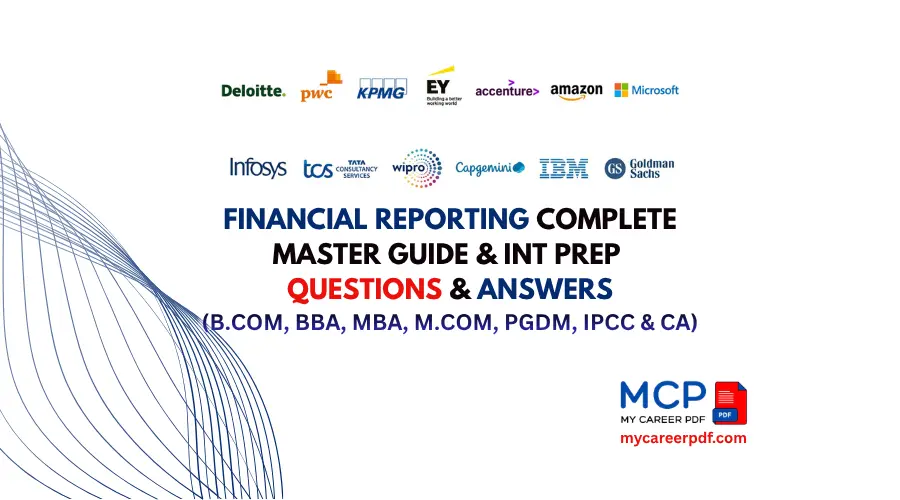
Financial Reporting professionals are in demand across Big 4 firms, multinational corporations, banks, investment management companies, and Global Capability Centers (GCCs).
Some of the leading employers include:
- Deloitte
- EY
- KPMG
- PwC
- Accenture
- IBM
- Capgemini
- Genpact
- Cognizant
- Infosys
- TCS
- Wipro
- HCL
- State Street
- Northern Trust
- Citco
- BNY
- JPMorgan
- Morgan Stanley
- BlackRock
- HSBC
- Barclays
- Citi
- Microsoft
- Amazon
- Oracle
- SAP
Preparing your concepts thoroughly can help you apply confidently across these organizations, as many Financial-Reporting interview topics remain similar.
Financial Reporting Salary in India
Financial Reporting offers competitive salaries with steady career growth. Although compensation depends on your location, company, qualifications, and experience, typical salary ranges in India are:
| Experience | Average Salary |
|---|---|
| Freshers | ₹3–6 LPA |
| 1–3 Years | ₹5–9 LPA |
| 3–5 Years | ₹8–14 LPA |
| 5–8 Years | ₹12–20 LPA |
| Managers | ₹18–35+ LPA |
Professionals with expertise in IFRS, SAP, Oracle, Advanced Excel, and Financial Statement Analysis often have better growth opportunities and higher earning potential.
Most Asked Financial Reporting Interview Topics
Most interviewers assess your conceptual understanding rather than your ability to memorize answers. Based on the topics covered in the Financial Reporting guide and interview preparation PDFs, candidates should focus on:
- Financial Statements
- Journal Entries
- General Ledger (GL)
- Record to Report (R2R)
- Account Reconciliation
- Month-End Close
- Year-End Close
- IFRS & Accounting Standards
- Revenue Recognition
- Financial Statement Analysis
- Variance Analysis
- Working Capital
- Cash Flow Statement
- Balance Sheet Analysis
- Depreciation & Amortization
- Accrual Accounting
- Financial Ratios
- SAP & Oracle Basics
- Advanced Excel
- Practical Accounting Scenarios
A strong understanding of these topics will significantly improve your performance during Financial-Reporting interviews.
10 Financial Reporting Interview Questions and Answers
Below are a few preview questions commonly asked during Financial-Reporting interviews.
1. What are the three primary Financial Statements?
The three primary financial statements are the Income Statement, Balance Sheet, and Cash Flow Statement. Together, they provide a complete view of a company’s financial performance, position, and cash movements.
2. What is the difference between Profit and Cash Flow?
Profit is calculated using the accrual basis of accounting, whereas Cash Flow represents the actual movement of cash into and out of the business. A profitable company can still face liquidity issues if cash collections are delayed.
3. What is the Accounting Equation?
The accounting equation is:
Assets = Liabilities + Shareholders’ Equity
Every financial transaction must keep this equation balanced.
4. What is Accrual Accounting?
Accrual Accounting recognizes revenue and expenses when they are earned or incurred, regardless of when cash is received or paid.
5. Why is Account Reconciliation important?
Account Reconciliation ensures that accounting records match supporting documents, helping identify errors and maintain accurate financial-reporting.
6. What is EBITDA?
EBITDA stands for Earnings Before Interest, Taxes, Depreciation, and Amortization. It measures a company’s operating performance before financing and accounting adjustments.
7. What is Working Capital?
Working Capital is calculated as:
Current Assets − Current Liabilities
It measures a company’s ability to meet short-term financial obligations.
8. What is the difference between CAPEX and OPEX?
CAPEX refers to expenditure on long-term assets, while OPEX includes day-to-day operating expenses required to run the business.
9. Why is the Month-End Close Process important?
Month-End Close ensures that all financial transactions are recorded accurately before preparing monthly financial reports, helping management make informed decisions.
10. What are IFRS Standards?
IFRS (International Financial Reporting Standards) are globally recognized accounting standards that improve consistency, transparency, and comparability in financial-reporting.
Financial Reporting Complete Master Guide & Interview Preparation Bundle
Preparing for Financial Reporting interviews can be overwhelming, especially when information is scattered across different websites, YouTube videos, and study materials. Many candidates spend weeks searching for interview questions but still struggle to explain concepts confidently during interviews.
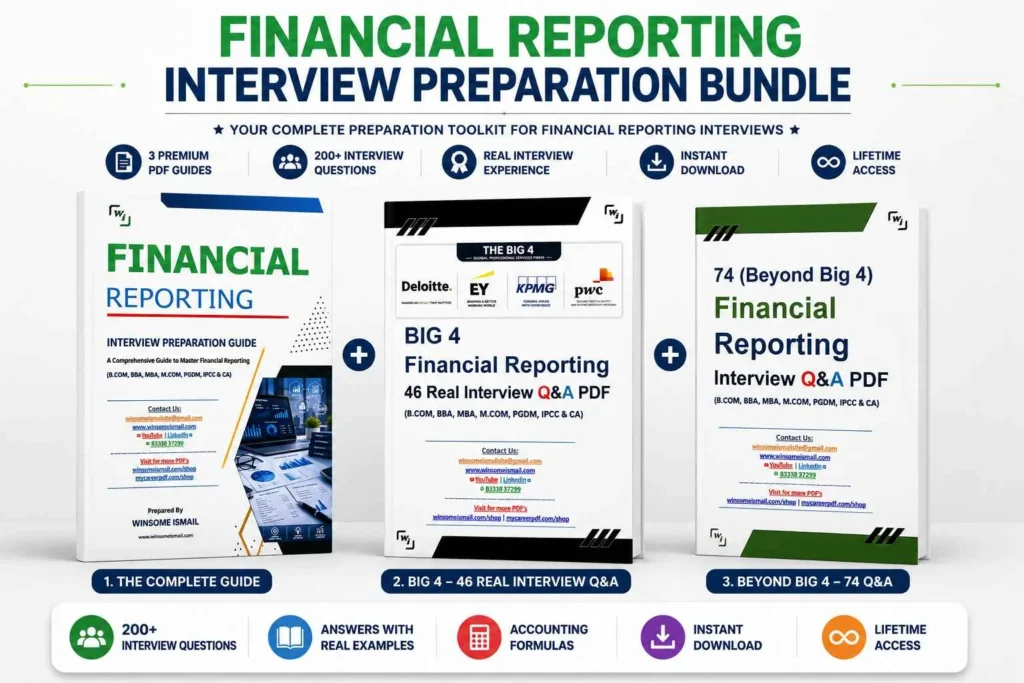
To solve this problem, the Financial Reporting Complete Master Guide & Interview Preparation Bundle brings everything together in one structured learning resource.
Instead of memorizing answers, you’ll build a strong conceptual understanding of Financial-Reporting while preparing for real interview scenarios.
What’s Included in the Bundle?
📘 1. Financial Reporting Complete Master Guide (359+ Pages)
A comprehensive guide covering Financial Reporting from beginner to advanced level.
Topics Covered:
- Accounting Fundamentals
- Financial Reporting Basics
- Financial Statements
- Financial Statement Analysis
- General Ledger (GL)
- Record to Report (R2R)
- Journal Entries
- Account Reconciliation
- Month-End Close
- Year-End Close
- IFRS & Accounting Standards
- Revenue Recognition
- Financial Ratios
- SAP & Oracle Basics
- Advanced Excel
- Practical Accounting Examples
- Interview Preparation
- Financial-Reporting Best Practices
The guide is structured to help readers progress from foundational accounting concepts to advanced Financial Reporting topics and interview preparation.
📗 2. BIG 4 Financial Reporting – 46 Real Interview Questions & Answers
This PDF focuses on interview questions reportedly asked during Financial-Reporting interviews at:
- Deloitte
- EY
- KPMG
- PwC
It includes technical questions, practical scenarios, and interview-focused explanations to help candidates prepare confidently.
📕 3. 74 Most Expected Financial Reporting Interview Questions
Designed for candidates preparing for interviews beyond the Big 4.
This resource covers questions commonly asked by:
- Multinational Companies (MNCs)
- Global Capability Centers (GCCs)
- Shared Service Centers
- Banking & Financial Services Companies
- Technology Companies
Topics include Financial Statements, IFRS, Revenue Recognition, Journal Entries, Financial Analysis, and practical accounting scenarios.
Why This Financial-Reporting Guide Is Worth Buying
There are countless free resources available online, but most of them provide fragmented information. This guide is designed to save you time and help you prepare in a structured, interview-focused manner.
Benefits of This Guide
✔ Covers concepts from beginner to advanced level
✔ More than 120 interview questions across the included PDFs
✔ Real interview questions inspired by candidate experiences
✔ Easy-to-understand explanations
✔ Practical accounting examples
✔ Covers Big 4 as well as leading MNC interview topics
✔ Helps improve technical and HR interview confidence
✔ Suitable for self-study and interview revision
✔ Instant PDF download with lifetime access
Whether you’re preparing for your first interview or planning your next career move, this bundle helps you focus on the concepts that employers commonly assess.
Who Should Buy This Guide?
This bundle is recommended for:
- B.Com Graduates
- BBA Graduates
- MBA (Finance) Students
- M.Com Students
- PGDM Students
- CA Aspirants
- CMA Candidates
- ACCA Candidates
- CFA Candidates
- Freshers
- Experienced Finance Professionals
- General Ledger (GL) Professionals
- Record to Report (R2R) Professionals
- Corporate Accountants
- Financial Analysts
- Candidates preparing for Big 4 and MNC interviews
Frequently Asked Questions (FAQs)
1. Is Financial Reporting a good career?
Yes. Financial-Reporting offers excellent career growth, competitive salaries, and opportunities across Big 4 firms, multinational companies, banks, and Global Capability Centers.
2. What skills are required for Financial-Reporting jobs?
Employers typically look for knowledge of Financial Statements, Journal Entries, General Ledger, Account Reconciliation, IFRS, Month-End Close, SAP, Oracle, and Advanced Excel.
3. Is this guide suitable for freshers?
Yes. The guide starts with accounting fundamentals before progressing to advanced Financial Reporting concepts, making it suitable for beginners as well as experienced professionals.
4. Does this bundle cover Big 4 interview preparation?
Yes. It includes a dedicated BIG 4 Financial Reporting – 46 Real Interview Questions & Answers PDF, along with a comprehensive Financial Reporting guide and additional MNC-focused interview questions.
5. Will this help with interviews at companies other than the Big 4?
Yes. The concepts covered are relevant for Financial-Reporting roles across multinational corporations, banks, Global Capability Centers, and financial services companies.
6. Does the guide include practical examples?
Yes. The guide explains concepts using practical accounting examples, journal entries, and interview-oriented scenarios to improve conceptual understanding.
7. Can experienced professionals benefit from this guide?
Absolutely. Experienced candidates can use the guide to refresh core concepts, prepare for technical interviews, and strengthen their understanding of Financial-Reporting topics.
8. How will this guide improve my interview preparation?
It provides a structured learning path, helping you understand concepts, practice interview questions, and build confidence before attending Financial-Reporting interviews.
Conclusion
Financial Reporting is one of the most rewarding career paths for finance professionals. With increasing demand across Big 4 firms, multinational corporations, banks, and Global Capability Centers, candidates who possess strong accounting knowledge and practical reporting skills have excellent career opportunities.
However, success in interviews depends on more than memorizing answers. Employers expect candidates to understand accounting principles, explain Financial-Reporting concepts confidently, and apply their knowledge to practical business situations.
The Financial Reporting Complete Master Guide & Interview Preparation Bundle has been created to help you prepare systematically. By combining comprehensive theory, practical examples, and interview-focused questions, it provides a complete learning resource for both freshers and experienced professionals.
If you’re serious about building a career in Financial-Reporting, investing in structured preparation today can significantly improve your confidence and interview performance tomorrow.
Get Your Financial Reporting Interview Preparation Bundle Today
Take the next step in your finance career with a structured interview preparation resource designed for Big 4 firms, multinational companies, and Global Capability Centers.
What’s Included:
- 📘 Financial Reporting Complete Master Guide (359+ Pages)
- 📗 BIG 4 Financial Reporting – 46 Real Interview Questions & Answers
- 📕 74 Most Expected Financial Reporting Interview Questions
- ✅ 120+ Technical Interview Questions
- ✅ Practical Examples & Accounting Concepts
- ✅ Instant PDF Download
- ✅ Lifetime Access
Prepare smarter. Interview with confidence. Build your finance career.